Including children in a pet farewell, gently and by choice
Tell children plainly what has happened, explain what they'll see at the farewell, offer them a small job, and let them choose whether to come. Nearly every parent wants help with this: 93.4%[1] in one large survey asked for better guidance.
By the Pet Funeral & Memorial Services editorial team · Updated September 24, 2026 · 5 min read · Sources
- Words to use, and words to avoid
- Jobs for toddlers through teenagers
- What to do if a child says no
The short answer
Should children go to a pet's funeral?
Usually, yes, if they want to and they know what to expect. With 59%[2] of UK households including an animal companion, according to peer-reviewed research on pet bereavement, plenty of children meet this loss early. In the US, by our estimate, around 5.6 million pet dogs[3] and 4.7 million pet cats[4] die each year, and many of them leave a child behind. Often it's their first experience of death, and a farewell gives shape to something confusing. Being part of it, even for two minutes, often helps more than being protected from it.
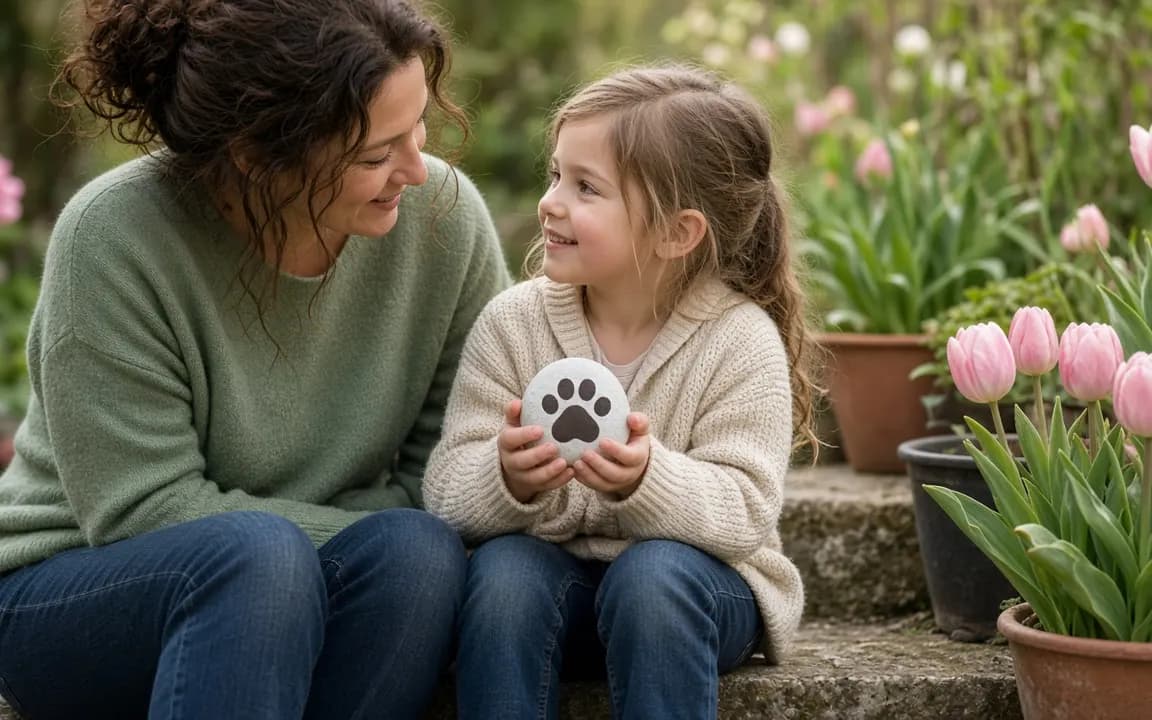
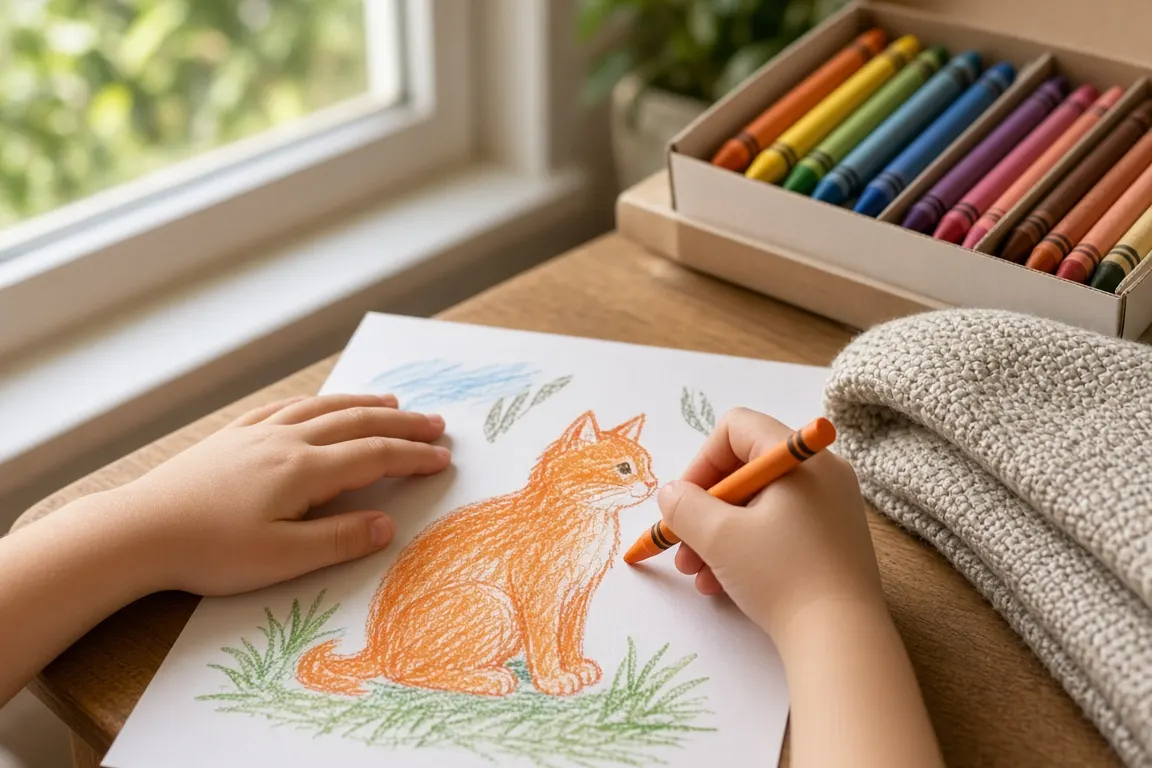
The key word is choice. Offer, explain, and let them decide. A child who says no should be told that's fine, and given another way to say goodbye, such as a drawing to go with the pet. Our pet funeral planning guide covers the rest of the day; this article is about the youngest guests.
Should young children be part of a pet's goodbye?
Tap an answer to vote and see how others answered. Anonymous.
Finding the words
What should you tell a child when a pet dies?
Use the real words: "died" and "dead". They sound harsh to adults but are clear to children. Phrases like "put to sleep", "went away" or "we lost her" can confuse or frighten young children, who may worry about going to sleep themselves or wonder why nobody is looking for the lost pet.
- Explain what dead means. "Her body stopped working. She can't breathe, eat or feel any pain anymore."
- Keep the cause simple and true. "She was very old and very ill, and the vet helped her die peacefully."
- Say it's not their fault. Children often secretly blame themselves, so say it out loud.
- Share your own sadness. Letting them see you cry shows them it's okay to feel this.
Pets matter enormously to children because they're family. In the RSPCA's survey of bereaved owners, 99.3%[5] saw their pet as family, a friend or a companion, and children feel that bond just as strongly.
Age by age
How do children of different ages understand pet death?
| Age | What they tend to understand | A good role at the farewell |
|---|---|---|
| Under 5 | Death may seem temporary; they may ask when the pet is coming back | Choosing a flower, holding a parent's hand, patting the pet goodbye |
| 5 to 8 | Beginning to see death as permanent; lots of practical questions | Drawing a picture to go with the pet, placing a toy |
| 9 to 12 | Understands permanence; may worry about other pets or people dying | Reading a short piece, lighting the candle, picking the music |
| Teenagers | Adult understanding; may hide feelings or grieve privately | Writing or giving the eulogy, carrying the pet, planning the ritual |
These are rough guides, not rules. A sensitive six-year-old may need more gentleness than a matter-of-fact four-year-old. Answer the questions they ask, honestly and briefly, and let them come back with more later. They often do, days or weeks afterwards.
The hardest question
Should a child see their pet's body?
Many families find it helps, as long as the child chooses to and knows beforehand what they'll see. Seeing that the pet is still and not breathing can make the death real in a way that words can't, and it can prevent imagined fears that are worse than reality.
Prepare them simply: "Buddy will be lying on his blanket. His eyes might be a little open. He'll feel cooler than usual, and he won't move." Let them touch or not. Stay beside them. If they want to leave after ten seconds, that's a complete goodbye.
Something to do
What jobs can children do at a pet farewell?
A job gives a child a reason to be there that isn't just being sad. It also gives them a memory of doing something for their pet. Ideas that work across ages:
- Choose which blanket or toy goes with the pet
- Draw a picture or write a short letter to tuck beside them
- Pick one song for the ceremony
- Scatter petals, or add the first handful of soil at a burial
- Hold the candle (with an adult) or ring a small bell
- Take a paw print with a parent's help
- Decorate a stone for the garden with paint pens
The farewell planner includes rituals like candles, letters and planting, so you can build a plan with space for a child's part. For older kids who want to speak, our guide to writing a pet eulogy has a three-sentence version that works well.

Free tool
Farewell & memorial service planner
Build a simple goodbye: who, where, readings, rituals and a checklist.
Respecting their choice
What if your child doesn't want to come?
Don't push. Say it's fine, and offer another way: a drawing that goes with the pet, a goodbye said at the door beforehand, or a job afterwards like choosing where the ashes will sit. Let them know they can change their mind up to the last minute.
Some children want to be nearby but not present, playing in the next room while the ceremony happens. That counts. If the farewell is at home, our step-by-step guide to holding a pet funeral at home covers the setup; plan a quiet space nearby for a child who'd rather not be in the room. Later, tell them briefly what happened: who was there, what was said, what the pet was wrapped in. Children often want those details more than adults expect.
The weeks after
How can you support a child after the farewell?
Expect grief to come in bursts: fine at school, then tearful at bedtime. Keep routines steady, mention the pet by name, and keep their photo up. Adults find this hard too. In the RSPCA's survey, 66.9%[6] of owners were surprised by how intense their own grief was, and 72.6%[7] lost their daily routine or sense of purpose.
- Make a memory box with the collar, a photo, and cards from the funeral.
- Plant something together, perhaps using the memorial tree finder.
- Mark the date in a year's time with a small ritual.
- Tell the school so teachers understand if your child is quiet.
If a child's grief seems stuck, or they're very anxious about other deaths, talk to their doctor or school counselor. For your own feelings, the private grief check-in can help you see where you are. And if you want to talk through aftercare options, send us a note.

Reader polls
What would you choose?
Vote anonymously and see how other readers answered. The results are live counts from people who visit this site, so they show real opinions, not a scientific sample.
Should young children be part of a pet's goodbye?
Tap an answer to vote and see how others answered. Anonymous.
Which ritual would you most want at a pet's farewell?
Tap an answer to vote and see how others answered. Anonymous.
What helped you most in the first weeks?
Tap an answer to vote and see how others answered. Anonymous.

Free tools to help you plan
Farewell & memorial service planner
Build a simple goodbye: who, where, readings, rituals and a checklist.

Pet loss grief check-in
A private, two-minute check-in on how you're coping, with ideas that match where you are.

Memorial tree finder
Pick a tree for a planting urn that suits your climate, space and pet.
Questions people ask
At what age can a child attend a pet funeral?
There's no minimum age. Toddlers can take part by patting the pet or holding a flower, though they won't fully understand. From about five, most children can follow a short ceremony if it's explained first. The deciding factors are whether the child wants to come and whether an adult is there just for them.
Should I tell my child the pet was euthanized?
Yes, in simple words suited to their age. Something like "The vet gave her medicine that let her die peacefully, because she was very ill and in pain" is honest without being frightening. Avoid "put to sleep" with young children, who may start to fear sleep.
Is it okay for my child to see me cry at the pet's funeral?
Yes. Seeing a parent cry shows children that sadness is a normal response to loss and that it's safe to feel it. Pair it with reassurance: "I'm sad because I loved her, and I'll be okay." Children usually find this comforting rather than upsetting.
How do I explain cremation to a child?
Keep it simple and gentle: "Her body will be taken to a special place where it's turned into soft ashes, and then we can bring them home." Reassure them that the pet can't feel anything. Older children may want more detail, which you can give honestly if they ask.
Should we get a new pet soon to help my child?
Many families wait until everyone, including the child, has had time to grieve. A new pet too soon can feel like a replacement and confuse the child's feelings. There's no fixed timeline; when your child starts talking about a future pet with excitement rather than sadness, that's a good sign.


Sources and our estimates
- [1] 93.4% of parents in the RSPCA survey wanted better guidance on helping children through pet loss. RSPCA — Pet Loss Survey Results, 2026.
- [2] 59% of UK households include an animal companion (Statista 2021, cited in peer-reviewed pet bereavement research). Coping with Animal Companion Loss: A Thematic Analysis of Pet Bereavement Counselling (PMC11017691), 2021.
- [3] At least about 5.6 million pet dogs likely die in the US each year (lower-bound style estimate using one dog per dog-owning household). Our estimate: US dog-owning households (71M) x 1 dog / US dog life expectancy (12.69 yrs). How we calculate.
- [4] Roughly 4.7 million pet cats likely die in the US each year. Our estimate: US cat-owning households (53M) x 1 cat / US cat life expectancy (11.18 yrs). How we calculate.
- [5] In the RSPCA's pet-loss survey (over 4,000 respondents), 99.3% saw their pet as family, a friend or a companion. RSPCA — Pet Loss Survey Results, 2026.
- [6] 66.9% of respondents were surprised by how intense their grief was after losing a pet. RSPCA — Pet Loss Survey Results, 2026.
- [7] After losing a pet, 72.6% lost their daily routine or sense of purpose, 69.8% had trouble concentrating and 65.9% had sleep problems. RSPCA — Pet Loss Survey Results, 2026.
Planning a family farewell for your pet?
Tell us what you need and where you are. We'll reply by email with clear options and prices so you can decide in your own time.